How the Flinn Foundation’s Five-Year Strategy Is Driving Systems Change in Mental Health
Over the past five years, the Ethel and James Flinn Foundation has invested deeply in strengthening mental health services across Michigan — from early intervention and workforce development to cross-sector collaboration and policy influence. As the Foundation reached the conclusion of its 2021–2025 strategic plan, it partnered with Tyler Logan, Founder of Black In Public Health, LLC, to step back and answer a critical question: How is this work contributing to real systems change?
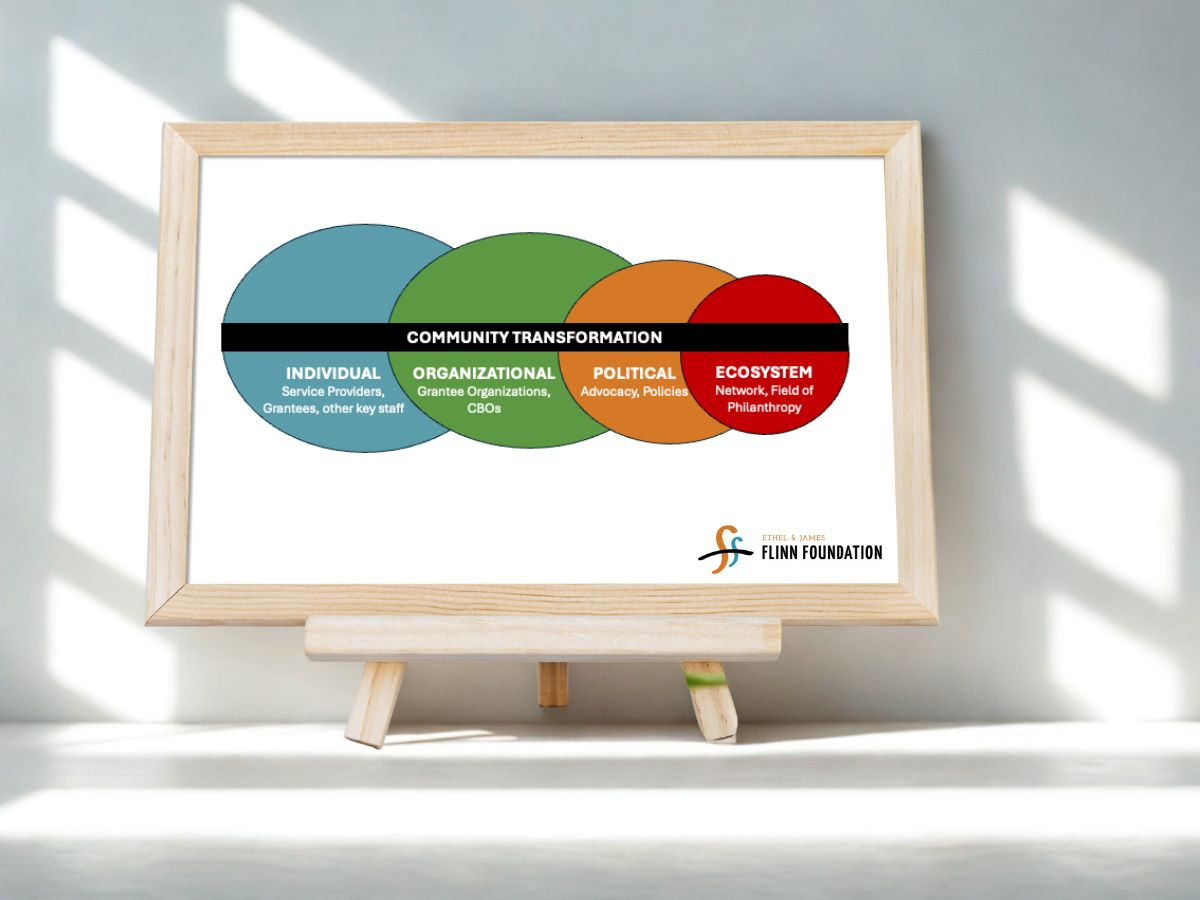
Logan served as Flinn’s learning and evaluation partner, synthesizing reports from 30 Flinn-funded organizations across the state. His work culminated in a December 2025 presentation to the Flinn Foundation Board of Trustees, where he introduced a refined Theory of Change — a framework that clearly shows how individual grants connect to broader, long-term impact.
“A theory of change helps make the through line visible,” Logan explains. “Flinn already had a strong mission, vision, values and strategic priorities in place. My role was to connect those dots and show how change is happening at multiple levels, not just within programs, but across systems.”
Rather than focusing solely on outputs or individual initiatives, the evaluation looked at outcomes across four interconnected levels: individual, organizational, political and ecosystem. What emerged was a clear picture of how Flinn-funded work is embedded within the systems people rely on every day, including health care, schools, justice settings and community-based services.
Building sustainable models of care
Across the portfolio, organizations are not only delivering services, but also building sustainable models of care. This includes integrating behavioral health into primary and perinatal care, strengthening workforce capacity through training and professional development, improving data-sharing and evaluation practices, and creating stronger partnerships across sectors.
“What stood out most was how deeply practical and systems-oriented the work is,” Logan says. “Grantees are embedding mental health into the places where people already are — clinics, schools, community spaces — and reaching populations that are often left out of traditional systems.”
A consistent theme throughout the evaluation was the importance of early intervention and prevention. Whether through school-based mental health programs, suicide prevention coalitions, perinatal mental health supports or youth justice diversion efforts, Flinn’s investments help connect people to care before challenges escalate into crisis.
From a public health perspective, Logan emphasizes that mental health needs develop over time. “When people can only access care once they reach an emergency, the costs are higher for individuals, families and systems,” he says. “Early connection to care supports healing, dignity and stability, and leads to more equitable outcomes.”
Philanthropy’s unique and important role
The evaluation also highlighted philanthropy’s unique role in advancing mental health equity.
While philanthropic funding cannot replace federal or state resources, it can move more nimbly, investing in trust-based partnerships, data infrastructure, workforce development and collaboration.
“Philanthropy isn’t just about funding services,” Logan notes. “It’s about investing in the conditions that make systems change possible — trust, partnerships, learning and sustainability.”
Over the past five years, the Flinn Foundation has increasingly focused on these conditions, contributing to stronger regional coalitions, shared data systems, and policy-aligned approaches that extend beyond individual grants.
As Flinn builds on the insights from this evaluation, the refined Theory of Change offers a clear foundation for the future. It reinforces the Flinn Foundation’s commitment to early intervention, prevention, culturally responsive care and systems-level impact while providing a shared framework for learning with grantees, partners and other funders.
“This work shows that change doesn’t happen in one place or at one level,” Logan says. “When investments align across individuals, organizations, policy and the broader ecosystem, that’s when you start to see real community transformation.”
Learn more about the Ethel and James Flinn Foundation. Visit flinnfoundation.org.